

The Seed Rock
A Northing story

The class of 1985 went up the overlook trail the third week of May, forty of them strung out along the rock in the wind, and Keith Marchand climbed the last of the krummholz two steps behind Dana Fournier because he had been walking two steps behind Dana Fournier since the fifth grade and saw no reason to change it on the last hike.
“They put us up here so we’d feel something,” she said when he came up level with her. She had to say it loud. The wind on the bare rock took the ends off your words and threw them down into the valley. “Look at Mr. Cyr. He’s waiting for us to feel something.”
Mr. Cyr, who taught earth science and had organized the hike, stood at the edge of the shelf with his arms folded, looking pleased, while the seniors spread out over the gneiss and did not feel much of anything except cold. Below them the whole watershed lay open, the main valley a dark trench of spruce running off to the south, a paler flat place at the far end where the trees gave out, the river showing here and there as a hard bright line where it caught the sun.
“I feel like my ears are cold,” Keith said.
“Write that down. Maybe you’ll get a B.”
They drifted off as they always did, out to the far end of the shelf where the old stone shelter sat with its back to the weather, and the noise of the class thinned behind them. Dana went in through the low door without asking anybody and Keith followed her, and inside it was suddenly still, the wind gone to a hum in the stones, the light coming grey through the one small window and the open door. Somebody’s rusted coffee can sat on the plank shelf with a notebook in it. The beam over the door was cut all over with initials, layers of them, some so old they were only shadows in the grey wood.
“People been signing this since before your grandfather,” Dana said. She ran her thumb over a set of numbers. “Look. Nineteen twelve, maybe. Or nineteen forty-two, I can’t tell.”
Keith took out the knife. It was his father’s, a cheap folding thing with a bone handle, and he had brought it up specifically, though he would not have admitted that. He set the point to the beam under a clear space and started to cut.
“You’re going to take an hour,” she said, watching. “Do just the letters.”
“It’s got to be deep or it doesn’t last.”
“Nothing lasts. That’s not the wood’s fault.” But she leaned against the stone and stayed while he did it, K, then M, then the year, digging the point in and levering out the grey until the pale wood showed underneath, and it did take a while, and she didn’t leave. When he finished she looked at it with her head tipped. “You spelled your whole self right. Good for you.”
“You want yours next to it?”
She didn’t answer that. She went back out onto the rock, and by the time he’d folded the knife and come after her she was standing at the drop with the wind pushing her hair straight back, watching three ravens work the face below the shelf. They hung on the updraft off the cliff without a wingbeat, black, tilting, one of them dropping and catching itself, sliding sideways along the rock and back.
“Four,” she said. “No. Five. There’s one down low.” She pointed. He never saw the fifth one. “You watch them long enough, it’s the same five every day, I bet. Same birds. They live here.” She said it like it settled something she’d been arguing in her head. Then, not turning around: “My aunt’s got a room over her garage. Bath and everything. She said September.”
He’d known it was coming. It had been coming since Christmas, since the mill went to two days and then went dark and the whole valley started talking low about who was leaving and who was stuck.
“September,” he said.
“You could come in September.” She turned around then. “I’m not asking you to marry me, Keith, God. I’m saying there’s a room and there’s two of us could split what it costs, and there’s actual work down there, my cousin does drywall and he can’t keep guys. It’s three hundred miles. It’s not the moon.”
“I got Denny.”
“Denny’s got a mother.”
“You’ve met his mother’s schedule.”
Dana looked at him for a second. The wind went between them. “Yeah,” she said, gentler. “I have.” And she let it go, because she was good at knowing when a thing wasn’t going to move, and they walked back to the class together and got in the school van and went down, and that was the last good easy day of it, though he didn’t know that yet.
She left the valley in October of 1986, a year and a month after the room came open in September, and the difference between September of ‘85 and October of ‘86 was the whole story of that year, which was a year of her waiting on him without ever once saying she was waiting.
His father got worse over it. There was a thing wrong with his father that the family didn’t have a clean word for, that had started as forgetting where he’d set the truck keys and had become, by that summer, his father sitting in the front room with the television on in the afternoon not watching it, and a smell in the house, and the checkbook needing to be kept where he couldn’t get at it. His mother worked the desk at the nursing home two towns over, and the joke that wasn’t a joke was that she’d have taken him there except they had no money and no bed and it would have killed her to do it. So there was Keith. Somebody had to be in the house when the bus dropped Denny, who was eight, and somebody had to be in the house so their father didn’t put a pan on the burner and walk away from it, and that somebody was nineteen years old and had a girl three hundred miles away in a room over a garage who called on Sunday nights.
They fought about it once, in the truck, in the gravel lot behind the IGA where they used to park because you could see the whole valley go blue and the radio came in clear off the ridge repeater.
“You could get a girl to sit the house,” Dana said. “You could get your aunt Lorraine.”
“Lorraine’s in Berlin.”
“Berlin’s forty minutes.”
“He doesn’t know Lorraine anymore. He gets scared of people he doesn’t know. He got scared of the meter reader, Dana, I had to walk the guy back to his truck.” Keith had both hands on the wheel and the truck wasn’t going anywhere. “You want me to hand my father to somebody he’s scared of so I can go hang drywall.”
“I want you to come with me before this place closes over your head like water.” She said it flat, looking out the windshield, not at him. “I’ve watched it. You watch a guy, he’s twenty, he’s got a girl, he’s got a plan, and then his father needs him, or the camp needs a caretaker, or somebody’s got to run the woodlot, and he’s forty and he’s still here and the girl’s a lady he waves to at the transfer station. That’s not going to be me. I’m telling you now so it’s not a surprise. That’s not going to be me.”
“I know it’s not.”
“So come.”
And he couldn’t. That was the thing he could never say to her, that it wasn’t the reasons, the reasons were all true but underneath them was a smaller thing he was ashamed of, which was that when he tried to see himself in the truck with the valley going small in the mirror behind him, his mind simply stopped, went white, would not make the picture. He didn’t know why.
“I’ll think on it,” he said, which was the lie they both agreed to sit inside for another few months.
She recorded him a tape in September. She brought it up to the house in a case with the songs lettered on side A in blue ballpoint, for keith across the top, and side B left completely blank.
“Why’s the other side empty?”
“Because that side’s for down there,” she said. “New stuff. Whatever’s on the radio when we get there. We fill it up together, that’s the deal. You keep it empty till then.” She put it in his hand and closed his fingers over it. “Don’t tape over it with the ballgame.”
He kept it in the truck. He did not play side A; he found he couldn’t. He kept side B empty as she’d told him to.
She set a date in October. She left him a message on the machine, and he came in from the barn with his boots still on and the little light was going, and it was her voice in the kitchen saying meet me down at the meadow, seven o’clock, and there was truck noise behind her voice so she was calling from the Gulf station, and then bring something, she said, and he never knew if she meant a thing to remember her by or himself, packed and ready, and the machine clicked off. He stood there and wrote it on the message pad in his own hand, meet me down at the meadow, 7, and he underlined her name at the bottom twice, and while the machine was rewinding he drew a little boat in the corner of the pad and didn’t notice he was doing it.
The meadow was where the two channels of the brook came together in the flat wide ground, and the sedge had gone to seed and the light was long and gold along the water when he got there, and she was sitting on the tailgate of her father’s truck with her boots swinging.
“You didn’t bring anything,” she said.
“I didn’t know what you meant.”
“No.” She almost smiled. “You never did.”
He came and stood in front of her and put his hands in his coat and couldn’t find the start of it, and she watched him not find it, and the water went by, and a kingfisher went down the brook rattling and neither of them looked at it.
“Say it, then,” she said finally. “Don’t make me stand here while you build up to it. I’ve been standing here a year.”
“My father put his hand on the stove Tuesday. Not the burner. The side. But he doesn’t feel it right anymore and he left it there and Denny’s the one smelled it and pulled him off.” He heard his own voice going and couldn’t stop it. “Denny’s eight. Denny pulled him off the stove. I can’t put that on an eight-year-old and drive to New Hampshire, Dana, I can’t, there’s nobody, there’s just me.”
“I know there’s just you.” She wasn’t arguing anymore. “That’s what I can’t fix. There’s just you, and you’re going to keep being just you, and one of us has to say it out loud so I’m going to. You’re not coming. Not September, not October, not next year. You’re going to be here.” She said it without cruelty, like a temperature read off a thermometer. “You’re the kind that stays. I found that out about you this year and I wish I’d found it out slower.”
“I’d have come. If it was just me. If there was nobody.”
“But there’s always going to be somebody. That’s who you are. You’ll find the one who needs you and you’ll stay for them.” She slid off the tailgate and stood close to him, close enough that he could have put his arms around her, and he understood he wasn’t going to, that the not-doing of it was already happening. “Give me the tape.”
“What?”
“The tape. Give it back.”
He took it out of his coat. He’d carried it up thinking, stupidly, that it was the something she’d meant. She took it out of his hand gently, as you’d take a thing off a kid who shouldn’t have it, and she looked at side B, the empty side, for a second, and then she put it in her own coat.
“Can’t fill it up alone,” she said. “Neither of us. It stays empty.” And she got in the truck, and she said, “All right, Keith,” through the open window, not mad, just done, and she drove out of the meadow and down the valley road, and he stood in the going-dark by the water and listened to the truck until the sound of it went under the sound of the brook and was gone.
He heard she got down there fine. He heard she got the drywall work and then something better, an office, and then he stopped hearing, because the people who’d have told him stopped seeing her too. She went into the south like water into the ground.
He started going up the ridge that winter because it was the one place the valley couldn’t talk to him.
Down in the house everything had a voice. His father, the television, Denny needing the bus, his mother on the phone with the county about a program they didn’t qualify for, the pipes, the furnace, the answering machine that never had her voice on it again but that he checked anyway, every day, like a man running his tongue over a broken tooth. But the ridge had no water in it. That was the strange thing he learned that first winter, that everywhere else in the valley the ground ran and seeped and muttered, and up on the bare rock all of that stopped, and there was only the wind, and when the wind dropped there was nothing at all. He would take the snowmachine up on a clear afternoon and sit in the lee of the shelter and let the nothing be there instead of the house.
The ravens were what he watched, because they were the only thing moving. They worked the face as they had the day of the hike, hanging on the wind off the cliff, and he thought about Dana counting them, four, no, five, saying they lived here, saying it’s the same birds. One afternoon in December he had the heel of a sandwich in his coat and no reason to carry it home, and there was a big raven working the near face close in, close enough to see the shag of feathers at its throat, and without deciding to he broke the bread and set it out on the flat rock beside the shelter where the wind kept a bare place, and he went back to the lee of the stone and waited.
The bird didn’t come while he watched. But the bread was gone when he got up to leave, and stamped all around the bare place in the skiff of snow were the tracks, big, three-toed, and off at one edge a single clean sweep where a wing had come down. He stood and looked at that a long time. It was the first thing since October that had answered him.
He started bringing seed. Sunflower and cracked corn in a coffee can in the machine’s box, out onto what he came to think of as the seed rock, and because he was his father’s son and his father had counted things, the weather and the wood and the hawks, he started keeping a count. A weatherproof card, ruled in pencil, kept in the can in the shelter with the older books. The date. How many. Which way they flew. The weather. And a narrow column on the right where he marked whether the seed had been taken, and the answer was almost always yes. Six, downvalley, ahead of a front. Pair, worked the face all afternoon. His hand went stupid with cold and dragged the pencil into smears. Something out in the cold was keeping its half of an arrangement he hadn’t known he was allowed to make.
In the shelter on the raw days he read the older keepings. There was a hardbound ledger, older than his notebook, filled in a careful clerk’s hand, that ran down the pages with the weather of some year and then simply stopped in the middle of an October, the rest of the ruled lines blank, and he never learned why a man would keep a thing that faithfully and then set it down mid-month and never take it up.
Denny started coming up the second winter, when he was nine and small for it and furious about being left out of anything.
“What do you write,” the boy said, the first day Keith let him watch the count get made. He was jammed into a snowsuit two sizes big and his face was the only part of him showing.
“How many birds. Which way. The weather.”
“Why?”
“So you know.”
“Know what?”
Keith thought about it. “Whether it’s the same as last time,” he said, which was as close as he could get, and Denny seemed to accept it, because to a nine-year-old that was obviously worth knowing.
The boy didn’t care about the valley. Keith tried once to show him how you read it, the dark band that was the river, the pale place at the bottom, and Denny looked for about four seconds and said “where’s the birds,” and that was the end of the geography lesson. What Denny wanted was the ravens, up close, as animals, and he’d been given a plastic camera for Christmas and one roll of film and he spent the whole roll on them.
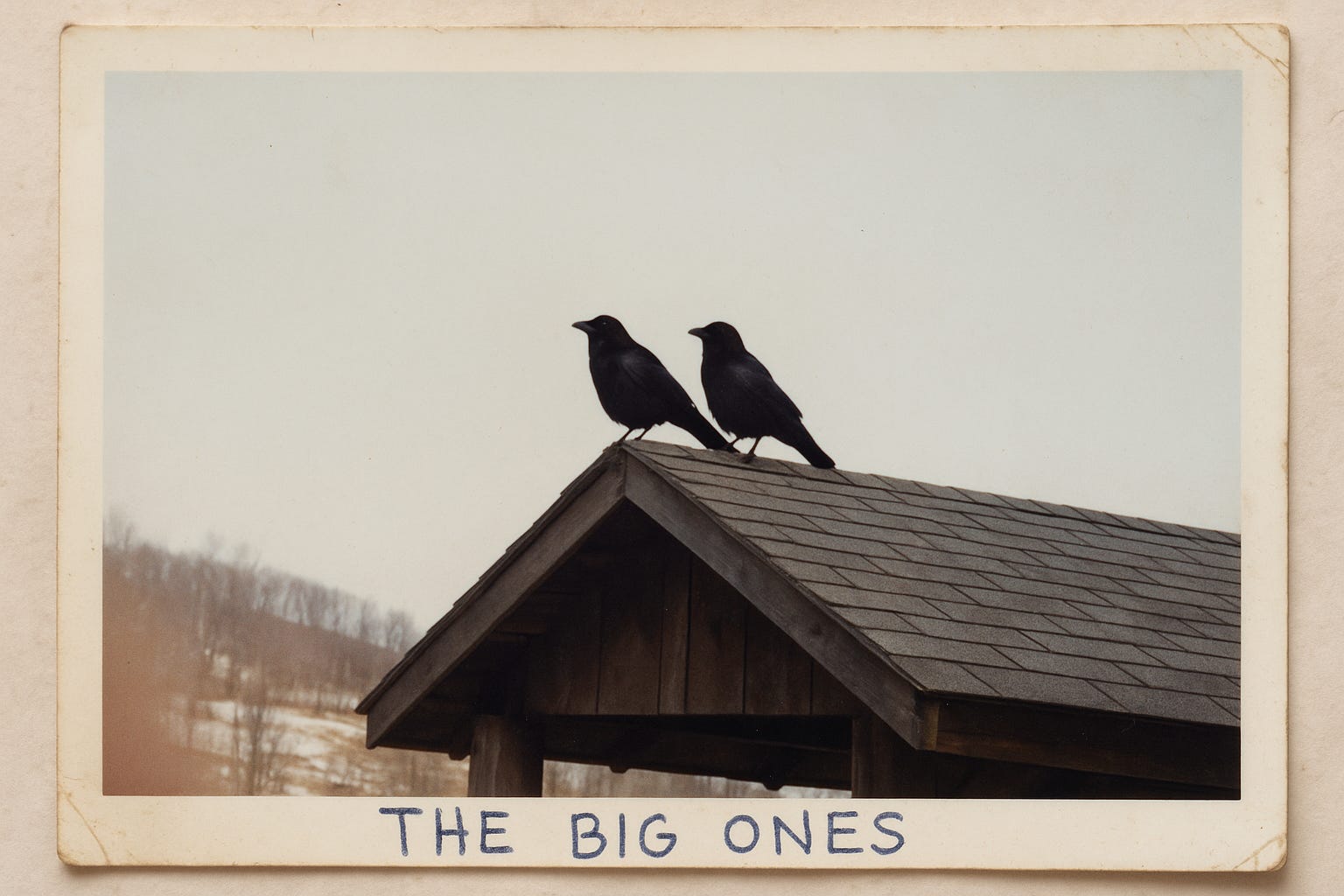
He was a terrible photographer and Keith kept every print. The horizon tips in all of them. The birds are always too far off and too small, dropped in the dead center of a lot of empty sky, and in the corner of half of them there’s the pink blur of a finger over the lens. But there’s one where two ravens are standing on the peak of the shelter roof in a light so bright it washes all the color out of the day and leaves the birds the one black solid thing, and along the white border in a nine-year-old’s block capitals it says THE BIG ONES, and Keith has that one still.
“They know you,” Denny said one afternoon, low, like it was a secret, watching the big one drop onto the seed rock while they sat still against the stone. It had the notch out of one wing that Keith knew it by.
“They know the seed.”
“No.” Denny was certain, as children are. “They know you. That one looked right at you.” And Keith didn’t argue it, because the boy wanted it to be true and because some cold part of Keith wanted it to be true too, and the two of them sat there in the lee of the stone and watched the bird crack corn, and neither of them moved.
There was one day that second winter Keith never squared, and after a while he stopped trying to.
It was late February, hard and clear after a front, the snow squeaking underfoot, and he’d come up alone because Denny had a cold. He climbed out onto the shelf and saw before he’d even reached the rock that the count was going to be wrong, that the seed on one side was already gone and worked over, the hulls split and empty, when he hadn’t been up in three days. And coming to the rock from the krummholz edge and going back down it were tracks. Boots. He crouched and set his own boot beside one and it wasn’t his, the print was narrower and longer and the tread was a pattern he didn’t own.
Somebody had come up. In February, a long way up in a bad season, to the one rock, and stood where he stood, and left again, and not signed the book. He went into the shelter and turned the notebook pages looking for a name and that was when he found that a page had been torn out, cleanly, close to the wire, so that only the ragged inner edge was left, and on the page underneath, pressed into the paper, the ghost of a hand that had written hard on the sheet above. He carried it to the door and turned it to the low sun and could not read it. He never could. There was never enough there, only the fact of the writing, the dents where a pen had gone.
He wanted it to be her. He built the whole thing standing there in the cold, that she’d come north for something, the Fourniers still being in the valley, and climbed up to the one place she’d know to find him, and found the count instead, the card in the can in his cramped hand, six downvalley ahead of a front, seed taken yes, and read off it the thing he’d never managed to say in the meadow, which was that he’d stayed and that staying had a shape and here was the shape. And that she’d written something down, her side of the empty tape at last, and then thought better of it and torn it out and carried it back down the mountain and gone south again without a word, because he was right and she was right and there was nothing up here she could use.
He built all of it. He knew while he built it that he was building it, that a man by himself on a ridge will make a woman out of a stranger’s bootprint because he can’t help it, that it was probably a hunter, or one of the last club men, and the torn page probably nothing, a grocery list somebody was embarrassed to leave. He held the two of them at once and didn’t choose, as his father used to hold the storm that was coming and the sun still on the rock in the same afternoon. He never found out. The seed was taken. The page was gone. Whose boots, and what was written, and whether she ever stood there, he was not going to be told.
He found the tape the next spring, when the snow went off the bench and the trail cleared.
It was at the crossing, where the path meets the brook, lying face up on the wet leaves as if it had been under the snow all winter and only come back with the melt, the cracked case beside it. Side A in her hand, for keith. Side B blank. The water had gotten into the paper along one edge and darkened it. He crouched there with it a long time and the brook went over its stones next to him, talking as water talks everywhere down in the valley and never does up on the rock.
He didn’t know how it came to be there. Maybe she’d carried it back that February, if it was her at all, and dropped it going down. Maybe it had worked loose out of his own truck a year before and he’d never missed it and the plow had carried it to the crossing. Maybe the crossing was only where things ended up, the low place where the water put down what it was carrying. He turned side B over. It was as empty as the day she’d handed it to him.
He put it in the coffee can in the shelter, with the count and the old ledger.
He got out in the end. Not that spring and not the next, but after, when there was finally nobody whose staying depended on his. Where he went after that the count does not say.
Denny kept the count. Nobody handed it to him and nobody wrote it down as a chore. He’d learned the arrangement in the two winters he rode up clamped to his brother’s back with his face out of the wind, and when the brother was gone the arrangement stayed. He scattered the seed. He marked the card, in a hand that got steadier every year. The ravens came ahead of the fronts and worked the face in the fall wind and got counted, and the count went into the can with the ledger that stopped in October and a cracked cassette with one side blank, all of it waiting up there for whoever came next.
Up on the seed rock the wind is still the only sound. It comes over the open rock with nothing to break it, and in the rare still hour when it drops there’s no water to fill the quiet, only the valley below, the dark band of the river working south toward the low ground where everything the country carries comes at last to rest. And on the flat rock most days, if you climb up to see, the seed is gone and the three-toed tracks are stamped all around the bare place the wind keeps clear, and at one edge, sometimes, a single sweep where a wing came down. No bird in the frame. Whoever left the seed already gone back down through the krummholz. And the count in the can says what it has always said, in one hand and then another, going back further than anyone can read: how many, which way, the weather, and the seed taken. Yes. Yes. Most days, yes.