

A Measure of a Place
Northing's premise, and the compact

A northing is a measurement. On a surveyor’s grid your position is fixed by two numbers, an easting and a northing, and the northing is the one that tells you how far north you have come. It is not a landmark or a name. It is a distance, read against a line someone once agreed to call the start.
Sailors kept northings too, in an older sense: the ground made good toward the pole after a day of wind and leeway, the gap between where you meant to go and where the water actually took you.
The Northing I created is named for that measure.
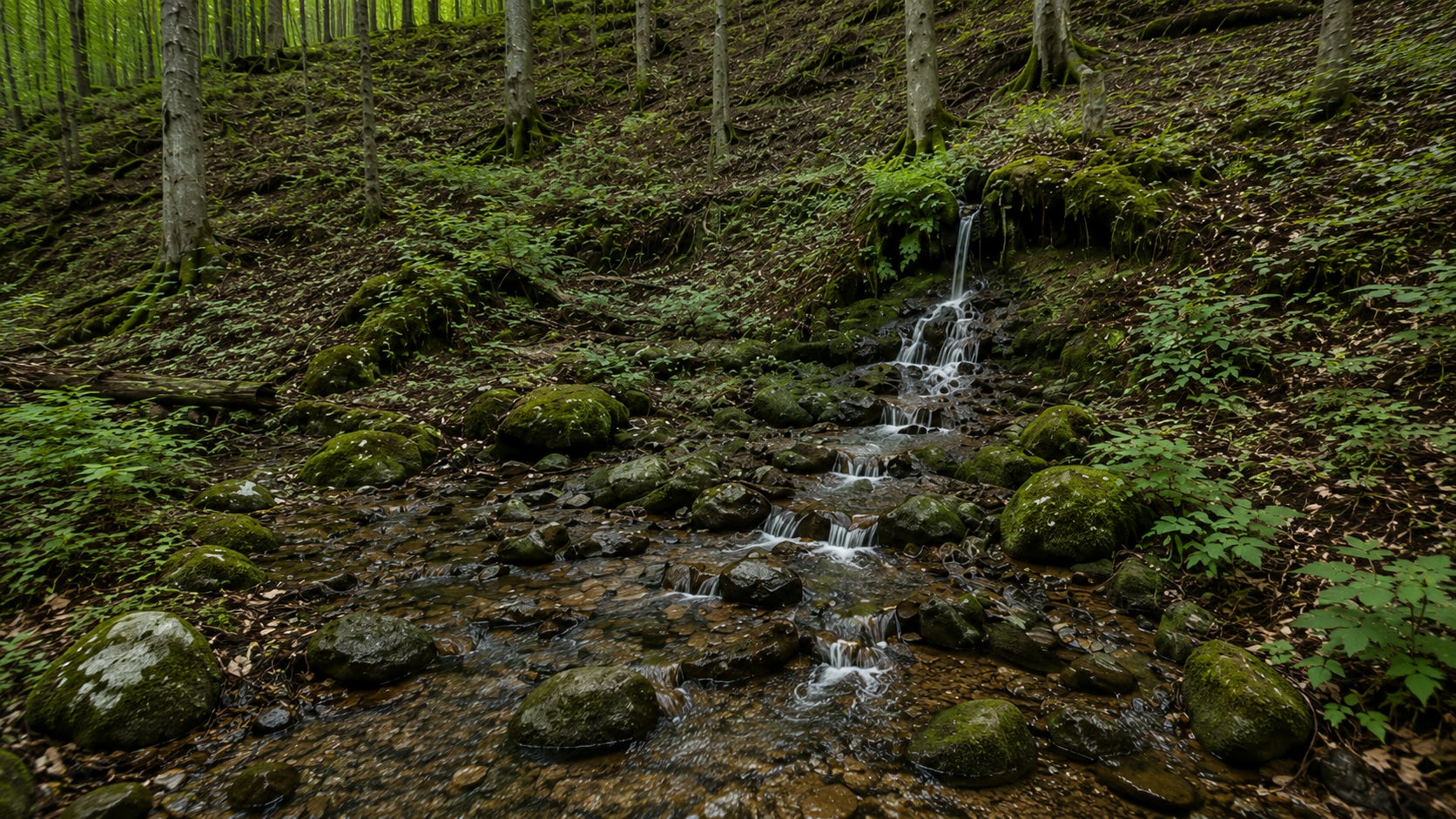
Northing is a place that does not exist on any map. It is a fictional watershed in New England: a cold spring at the head of a valley, a few brooks that gather into one, the ground the water made and goes on making, a ridge above it, an orchard gone wild, the stone print of a house that is no longer standing.
It was built, piece by piece, until it became somewhere I could return. The spring, the ridge, the orchard, the abandoned foundation, the crossings between them. None were discovered, but none are arbitrary. Once the ground was established it acquired its own constraints, and every addition since has had to answer to them. A made place can become as demanding as a real one if its maker is willing to be governed by it.
What interests me is not invention for its own sake, but what sustained attention can do once the ground is stable enough to support it.
I return to the same places because familiarity changes what can be seen. The first visit notices the meadow. The fifth notices that one alder has fallen since spring runoff, or that the light reaches farther into the orchard after a single tree comes down. A thing seen repeatedly becomes different from a thing merely described. Meaning arrives that way, by accumulation more often than explanation.
Some weeks these letters will simply be observations from somewhere in the watershed. Some weeks they will concern the making itself, the slow work of building a place that remains consistent enough to surprise its maker. Some will wander outward into questions suggested by the landscape: water, records, memory, weather, ordinary objects, the traces people leave behind. Others may consist of little more than a season turning.
Here we are in the middle of July, an odd time to begin watching a year.
The watershed is at its fullest and its lowest at once. The leaves are as heavy as they will get, while the brooks have already withdrawn into their beds, quiet enough now that you hear individual threads of water moving through stone. Everything looks finished and is not.
In a few weeks the first goldenrod will open along the roadside, and the year will begin, quietly, to tip.
I intend to be there when it does.